
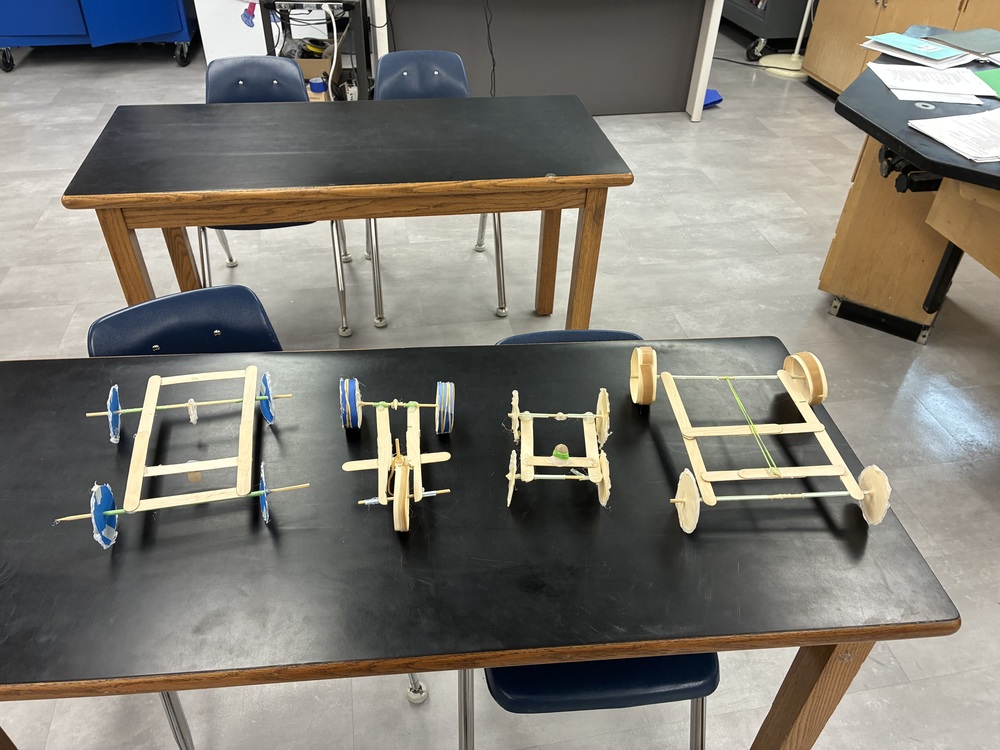
This February, 9th-grade Physical Science students were building rubber-band-powered cars. This experiment puts their creative engineering skills to the test, while also helping them develop a better understanding of potential and kinetic energy.
There are two main rules for this challenge. The cars must be powered only by the rubber band, so pushing, throwing, and slingshotting are not allowed. The only materials that can be used are rubber bands, glue, file folders, popsicle sticks, bamboo skewers, paperclips, and straws. Students were given three chances to build their car, revising their designs based on its weaknesses. This gave them a chance to create the best design they could. The goal was to design and build a car capable of traveling as far as possible.
Although it may seem easy, making a successful rubber band car was tedious. One of the more challenging aspects was the amount of detail required. Even a small mistake when building could drastically affect your results. Luke Olsen, one of the participants, stated, "The main challenge for me was making sure the wheels were aligned properly." A couple of the students said this was difficult because it takes a lot of tweaking for it to run correctly.
Our school does this project because the state standards require students to create a machine that transfers energy from one form to another. Mr. Lemoine chose the type of machine that would be created for this project. According to Lemoine, “It helps build academic resilience because they can’t give up after the first try, as it almost never works on the first attempt.” Along with “building academic resilience”, it also gives students a chance to come up with their own unique designs.
Mr. Lemoine likes doing this experiment, partly because of the challenge involved and how it pushes students. He stated that he also likes it because "the kids usually have no idea how to make it work at first, and they have to apply themselves." Kassie Loutzenhiser, another student involved, said that she liked this experiment because "It was a good way to show what we learned this unit."
Overall, this experiment was an enjoyable way to learn about energy and demonstrate the concepts taught in class. Building these cars was a friendly competition based on science concepts. This project drew the students’ attention to detail, helped them build academic resilience, and overall, allowed them to show off what they learned in their Kinetic and Potential Energy unit of physical science.—By George Teeple